
Anyone who followed the awkward, and ever so slightly insidious bromance between Donald Trump and Gianni Infantino which has been increasingly dominant in coverage of the build up to the impending, expanded World Cup across the USA, Canada and Mexico, might be forgiven for wondering if FIFA's current head honcho had bothered to read the history books. Starting with his parental homeland's hosting of the second tournament in 1934…
There's long been debate over how much of those hosts' eventual lifting of the trophy on home soil was down to skill on the pitch and what percentage might have been down to the machinations of Benito Mussolini, the dictator who sought to put fascism over football. Something Infantino should perhaps be slightly more wary of given his enthusiastic patronage of Russia's 2018 bid as well as Qatar's successful 2022 run and Saudi Arabia's subsequent unopposed canter to hosting in 2034, at his instigation.
A look back into the mechanics of Italy's choice as hosts back in '34 reveals a first ominous detail in that the decision was taken by the FIFA executive committee of the time minus any attempt at a ballot, 3.5 million Lire the budget given over to the organisation of a first European hosting of the World Cup. This edition was also the first time teams were required to qualify instead of simply accepting an invitation to compete, as had been the case at Uruguay 1930, when sixteen teams, whittled down from thirty-two, would take the field in a complete reversal of what seems to be happening now. A slide from only the best of the best making it to something unnecessarily accommodating and arguably serving only FIFA's best interests.
Way back when, even the Italians had to qualify- winning a match against Greece to do so. A 4-0 win in Milan got them there after the opposition pulled out ahead of the return leg in Athens. World Cup stories suggest skulduggery was afoot well before the men in blue would kick off the tournament opener against the United States.
“The Greeks, who had already sold 20,000 tickets for the return leg, suddenly withdrew from the competition. The Italians were spared an awkward and lengthy trip to Athens a month before the tournament, and were able to focus on preparing for it at home. According to FIFA’s website, the Greek team withdrew because they were ‘discouraged by the heavy loss’, but 60 years later a more sinister picture emerged.
A report from the International Federation of Football History and Statistics (IFFHS) claims that the cash-strapped Hellenic Football Federation- the sport’s governing body in Greece- were pressured into withdrawing by the Italians, who were understandably desperate to succeed on home soil with Mussolini watching closely. All the gate receipts would have been kept by the federation hosting the game, so abandoning it would have been a financial blow for the penniless Greeks, especially after the expense of sending a team to Milan for the first leg.
It was alleged that the Italian FA compensated them by purchasing a house in Athens, worth $400,000 in today’s money, and gifting it to the Greek FA to use as headquarters. In a statement published in Italian newspaper La Repubblica in 1995, the then IFFHS president Alfredo Pöge went further, based on testimony from future Greek coach Antonis Migiakis and three other living members of Greece’s 1934 squad. They insist that in addition to the “worthy and elegant home” received by the federation, key figures and players in Greek football were paid for their silence.“
After finding their way over the hurdle of qualifying following quite the leg-up, no group stage meant a straight ahead last 16! And the first-time champions weren't even there, the Uruguayans having boycotted and mirrored the refusal of several European sides- including the Azzurri themselves, to make the trip to South America in 1930. That particular continent's sole representatives- Argentina and Brazil- found themselves making the long journey home after just a game each in Rome and Genoa respectively after Spain and Sweden put three goals past them.
Meanwhile, the hosts, as alluded to above, gave the United States something of a stuffing, 7-1 to start proceedings With Mussolini making a show of standing with the general public and paying for his own match ticket in a first retrospective hint at something of a helping hand, as Michael Cox wrote for the Athletic of the pre-tournament background and reorganisation of the FIGC- Federazione Italiana Giuoco Calcio, or Italian FA.
“Mussolini had realised, perhaps before any other political leader, the power football had over people. In the mid-late 1920s his regime reorganised the Italian FA to give him direct control over key appointments, and it could be argued he effectively invented Serie A in 1929, as previously there had been northern and southern Italian championships. He desperately wanted Italy to host a World Cup. And he desperately wanted Italy to win it too.“
Just how desperate he was, should be the next question to ponder.
“Italy had a win-at-all-costs mentality which went beyond anything that could be considered acceptable now or then, including brutal levels of physicality and suspicious refereeing performances.“
The Football History Boys also bring to the table just how much this was about him and not just his country.
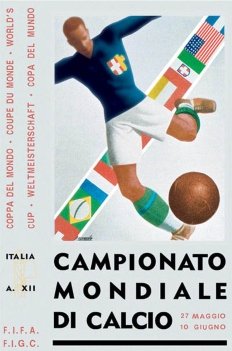
Italy was led by fascist dictator Benito Mussolini and his policy surrounded the 'cult of personality'. Il Duce, as he was known, prioritised being seen as the perfect man and perfect leader, done through both propaganda and force. Part of Mussolini's methods of winning support and public approval were through the promotion of sport. Il Duce was a keen follower of football and active sportsman himself, the chance to host a World Cup in 1934 was the ideal opportunity to magnify Italy on a grand stage. A mass propaganda campaign followed in Italy with posters, stamps, cigarette cards and anything else promotional available used to ensure Italy would be glorified through the feast of football.
A major role in this 'cult of personality' was sport because Mussolini saw it as a means of expressing fascism’s demand for "individual dedication to the greater collective need". His order to all competitors who represented Italy was: "Remember… When you compete abroad, the honour and sporting prestige of the nation is entrusted to your muscles and above all your spirit" Much greater than playing abroad, these Italian footballers had the daunting honour of standing for their country on home soil.“
A sobering lesson from the past, which we must hope for the good of the global game doesn't become a harbinger of its future. Next in this series, back in the (former) USSR...